J. L. Austin in Springfield (3)

In the last couple of posts, I’ve discussed some of the ways in which The Simpsons (Seasons 3–8) uses music to draw attention to the nature of the speech act and its contradictions, in a spirit that I’ve compared to J. L. Austin’s ordinary language philosophy. I’ve addressed the speech act’s propensity for failure (or ‘infelicity’) and the question of sincerity vs truthfulness, via the idea that to sing rather than speak a given utterance is to ‘do something else’ at the same time: something ‘musical’. But what is the nature of this ‘other’ mode of action and how does it relate to the speech act that it usurps (or ‘parasitises’, to recall Austin)?
Before turning to our penultimate (and most iconic) Simpsons example, let us return quickly to Homer and Lurleen Lumpkin on the bed. Recalling Austin’s distinction between illocutionary act and perlocutionary effect, we might ask why Lurleen (along with so many other real and fictional serenaders) chooses to sing her proposition (‘Bunk With Me Tonight’), rather than speak it. I’ve argued that, as a mode of ‘non-speech’, it adds an element of euphemism or plausible deniability, but it also does something positive. In the manner of mythical musicians like Orpheus or the Pied Piper of Hamelin, Lurleen’s song aims to seduce, beguile, persuade, convince. If its illocutionary force is one of proposition, its intended perlocutionary effect is to convince Homer to accept the proposition. In this, her song fails, but this is a source of comedy (and pathos) largely because we do not expect it to. Homer hasn’t just misheard its illocutionary force; he has misheard its perlocutionary force. How do we know this? Because it is (represented as) a good song, a beautiful song, an artful song. And — conventionally — the more beautiful the song, the more convincing it sounds. We hear the artistry of Lurleen’s music as the artfulness — and thus the efficacy — of her rhetoric.
Bearing this in mind, let us proceed to the most famous of all Simpsons song acts…
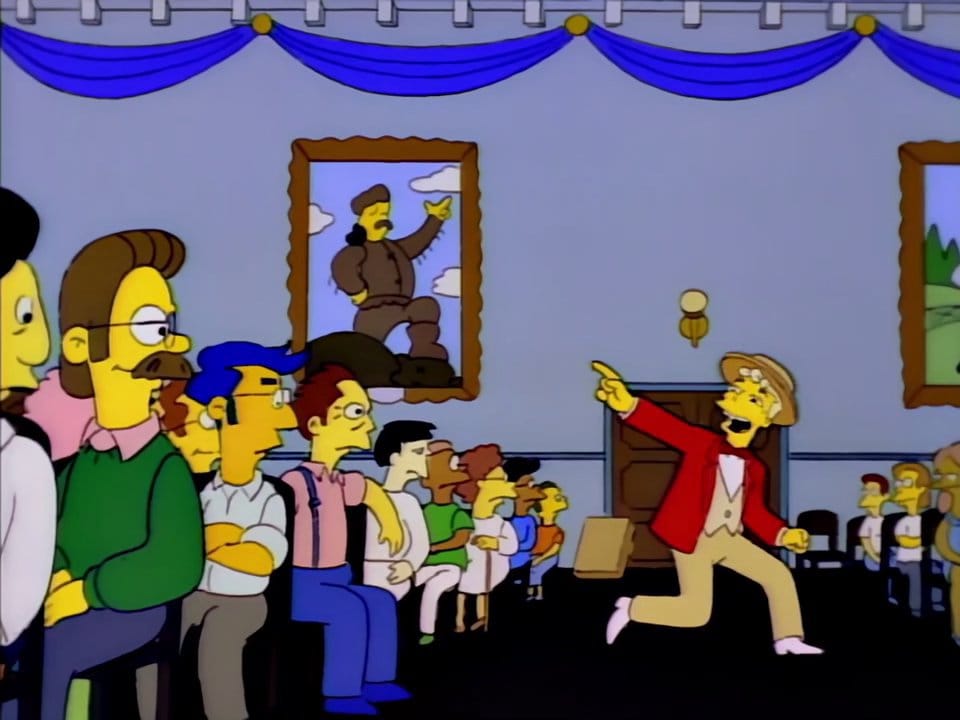
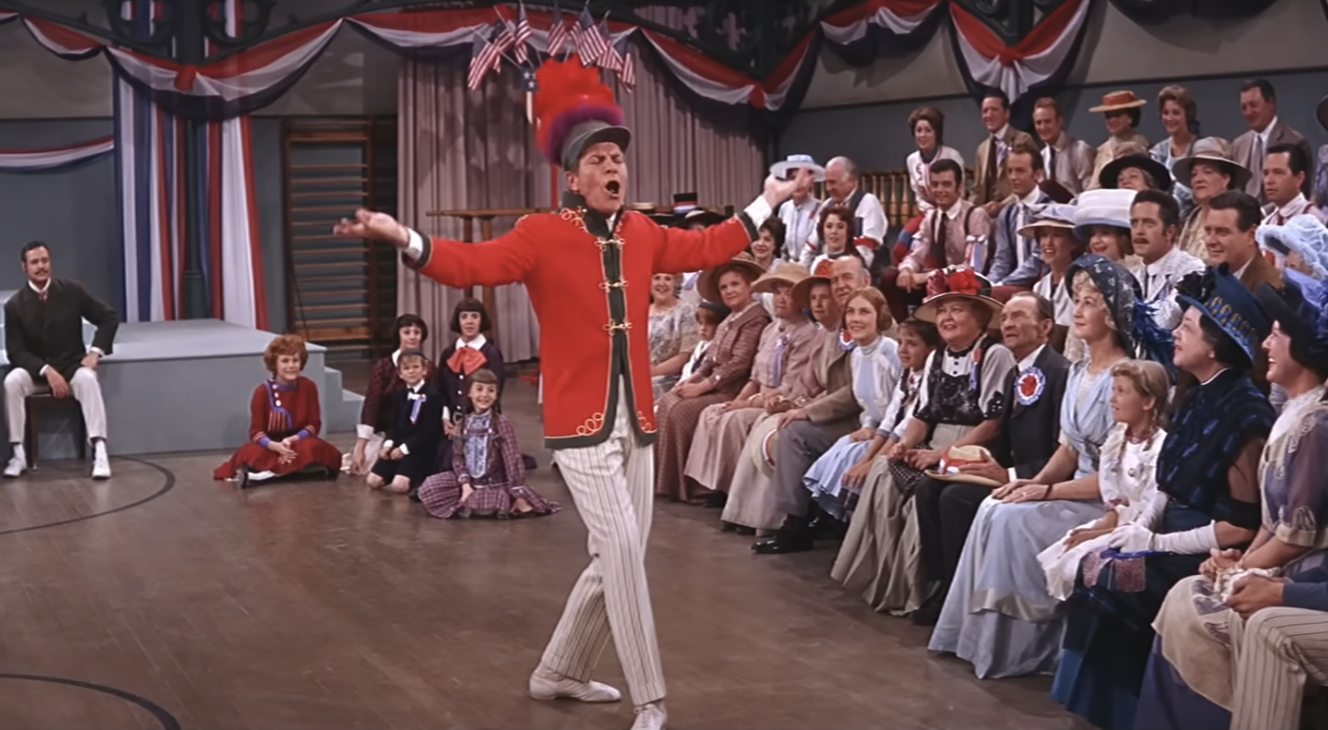
Here we have travelling monorail salesman Lyle Lanley appearing mysteriously at a town meeting in which the people of Springfield are deciding how to spend an unexpected budgetary windfall. The episode (Season 4 Episode 12, ‘Marge vs. the Monorail’) parodies the 1957 musical The Music Man, with this scene effectively combining two of its better-known numbers: ‘Ya Got Trouble’ and ‘76 Trombones’. The function of ‘The Monorail Song’ mirrors that of its source material, wherein travelling huckster and phoney ‘instrument salesman’ Harold Hill convinces a town to purchase all the necessary equipment for a marching band, with no intention of providing said equipment.
Clearly, Lanley’s ‘Monorail Song’ is a song act that does not fail. If anything, it is too successful; its success is patently illegitimate, unearned. The Simpsons writers borrow from what was initially a satire on the power of rhetoric, but they extend this satire to critique the idea (implicit in The Music Man) that music (which is to say, aesthetically ‘good’ or ‘artful’ music) might legitimately stand in for and thus satirise this rhetoric. Because... ‘The Monorail Song’ is barely a song at all! Lanley himself never actually sings, maintaining instead a rhythmic spoken patter that directly recalls ‘Ya Got Trouble’. Yet the number is described after the fact by Homer as a ‘song’, responding to Marge’s scepticism: ‘You should have written a song like that guy!’ (the meta-joke returns).
What is the nature of this ‘song’ that Lanley has ‘written’? He introduces it in terms of an ‘idea’:
LANLEY: I come before you good people tonight with an idea: probably the greatest… Ah, it’s not for you. It’s more of a Shelbyville idea!
QUIMBY: Now wait just a minute! We’re twice as smart as the people of Shelbyville. Just tell us your idea and we’ll vote for it!
LANLEY: Alright, I’ll tell you what I’ll do! I’ll show you my idea!
What is this ‘idea’ that is to be ‘shown not told’? The idea is the word ‘monorail’, which Lanley induces the townspeople to repeat initially as a simple word: ‘What’d I say?’, ‘What’s it called?’. The chanted repetition of these three(ish) syllables becomes the rhythmic basis for Lanley’s ‘song’, through the addition of a basic piano vamp, a minimal injection of music into what is otherwise a highly conventional speech act situation: the formal deliberation of a proposition, followed by a vote. Over the top of the repeated chant, the townspeople voice individual concerns which Lanley assuages with pat rhymed rejoinders, before making his final pitch — ‘I swear it’s Springfield’s only choice/Throw up your hands and raise your voice’: a speech act of swearing and of exhortation, coinciding with a new harmonic progression that demands a final refrain in order to cadence back to the tonic. This refrain, which constitutes the only real moment of ‘singing’, converts the chanted ‘Monorail’ into a song act — ‘Monorail! Monorail! Monorail!’ — heard, retrospectively, as a unanimous vote: ‘Sorry Mom, the mob has spoken!’.
Scott McMillin’s book The Musical as Drama offers some useful insights here. He describes the refrain as a device that produces a sort of self-justification for a song’s iteration beyond content/context:
There is something internal to the repetitions in a song that justify the song’s projection, regardless of context. [… The] refrain seeks to become its own signifier through repetition, and this approach to transparency—where the words and tune being heard refer to themselves through repetition—lifts the song to another layer of reference above the normal agony of being “about” love or “about” the blues. The other layer makes the song about itself. [McMillin 2006: 109–110]
Lanley is likewise exploiting what McMillin calls ‘the ensemble effect’: the ‘drive toward ensemble performance in the musical dramatic form’ (2006: 78). According to this principle, one character bursting into song has the effect of compelling others to join until everyone onstage is singing the same thing. McMillin associates this with the sentimentalist ideology of Rogers and Hammerstein — the musical as a demonstration that ‘community spirit prevails’ — while also discussing ways in which the convention has been exploited for ironic purposes, in shows like Cabaret and A Chorus Line (2006: 81, 93–101).
The repetition of the refrain compels further repetition and the ensemble effect compels mass participation, but the chanting of ‘Monorail’ is initiated within a speech act situation (the town hall meeting) in which context does matter: in which the utterance of these three syllables is bestowed with the illocutionary force of a true performative. Before we know it, Mayor Quimby’s promise has been fulfilled and the whole town has voted unanimously for Lanley’s idea. The speech act of ‘voting’ is felicitous, but we nevertheless experience it as an Austinian ‘abuse’. The townsfolk do not really know what they’re voting for; they’re caught up in Lanley’s ‘razzle-dazzle’ rhetoric. This returns us to Chicago’s ‘We Both Reached for the Gun’, in which lawyer Billy Flynn’s iteration of the titular refrain to a catchy hook — the crucial clause in Roxy Hart’s defence — seemingly compels the assembled press to regurgitate it as fact. As with ‘The Monorail Song’, there is a shift from ‘mention’ to ‘use’: the initial repetitions constitute ‘re-citations’, but these eventually become affirmations on behalf of the chorus itself.
If we shift our attention to the rhyming-couplet ‘Q&A’ that precedes the final refrains ('I hear those things are awfully loud'/'It glides as softly as a cloud'), we can see another powerful ‘musical’ tool that links back to the Simpsons examples already discussed. Through rhyming, Lanley’s rejoinders to the townspeople’s various concerns perform their own ‘fittingness’ or ‘acceptability’ as responses: they sound right by sounding right. This invokes the psychological phenomenon of ‘rhyme as reason’ (or ‘assonance as assent’), whereby rhymed aphorisms are taken to be more truthful than unrhymed ones (McGlone & Tofighbakhsh 1999). This has also been called the ‘Keats heuristic’, in that, by mixing up the logical with the aesthetic, it suggests that ‘Beauty is truth/Truth beauty’. Nietzsche describes this same effect in The Gay Science: ‘Even now… the wisest among us are still occasionally fooled by rhythm — if only insofar as we sometimes consider an idea truer simply because it has a metrical form and presents itself with a divine skip and a jump’ (quoted in McGlone & Tofighbakhsh 1999: 239–240).
Apu relies on this same phenomenon in his own ‘song-and-dance’ act, discussed in the previous post: ‘Who needs the Kwik-E-Mart?/Now here’s the tricky part/Oh, won’t you rhyme with me?’. As with ‘Monorail’, the rhyming game initiated by Apu ends up taking up most of the song, but it is a case of deflection rather than dishonesty: the burden of the rhyme is put onto the family who, in succeeding (or, in Homer’s case, failing) to come up with a rhyme, give credence to a purely aesthetic performance of consonance, only tangentially related to the question at hand. Rhyming couplets also form the meat of Mr Burns’s ostentatious display in ‘See My Vest’: items of clothing rhymed with the animals from which they are made. And it is through the failure to rhyme artfully (‘jar of love’ with ‘glove of love’) that Kirk van Houten’s attempted reconciliation song attains some of its pathos.
If we follow this logic outwards to consider the peculiar mode of sung action more broadly, we get a sense of why the injection of ‘music’ might make a rhetorical act so extra-ordinarily compelling. As before, the key lies with Austin’s concept of ‘perlocution’ — the effects or consequences achieved through an action — a concept that was taken up by his student Stanley Cavell. In his Foreword to Shoshana Felman’s The Scandal of the Speaking Body, Cavell writes the following:
Illocutions, we might say, can name what they do (to say “I promise, bet, wed, announce,” etc. is to promise, wed, etc.); perlocutions cannot in this way name what they do. If apparently perlocutionary acts (uttering “I deter, punish, alarm, amaze, disgust, seduce, delight, etc. you”) were eo ipso (as Austin likes to say) to deter, punish, alarm, disgust, seduce, delight you, speech would essentially, over an unsurveyable field, be a form of magic (as if it were throughout that field set to unheard and irresistible music). [Cavell in Felman 2002: xix; see also Cavell 2005: 172]
But what if this magical irresistible music weren’t in fact unheard? It is a central tenet of my thesis that we might profitably think about singing as an utterance that performs its own perlocutionary efficacy in and through its iteration. What we hear when we hear ‘Bunk With Me Tonight’ as an aesthetically successful ‘song act’, for instance, is Lurleen performing the success of her proposition — its irresistibility. Homer himself recognises this, declaring ‘There isn’t a man alive who wouldn’t get turned on by that!’ (before immediately proving himself wrong). But for Lyle Lanley — a musical rhetorician in the mode of Orpheus or the Pied Piper — to sing ‘I convince you’ is to convince you. He’s not just telling you his idea, he’s showing you the idea’s undeniability.
It is part of the ambiguity of The Music Man that, despite Harold Hill’s supposedly bad intentions, even his acts of deceit are seen retrospectively as having positive effects on the townspeople. In order to sell them his non-existent wares, he infects them with a passion and desire for music, and we are shown that these qualities are valuable enough in themselves to absolve his actions. By the end, we see that his means (deceitfully ‘musical’ rhetoric) produce their own ‘ends’ (a general ‘musicalisation’ of the town), independent of their infelicities (the lies, the broken promises, etc). We might link this ‘passion’ — which enters rhetoric as music — to Cavell’s category of ‘passionate utterance’ through which he discusses the perlocutionary act (with occasional reference to sung utterance, primarily opera) (Cavell 2005: 155–191). Thus, despite having no musical credentials or expertise, Harold Hill is shown to be a true ‘music man’ after all, comparable in ways to Mary Poppins or Maria von Trapp. Not so Lyle Lanley, who can play the piano, but whose monorail delivers no folksy benefits to the townspeople whatsoever.
The illegitimacy of the perlocutionary act in ‘The Monorail Song’ can be contrasted with our final example: the show’s most conventional musical-style number, ‘We Put the Spring in Springfield’ (Season 8 Episode 5, ‘Bart After Dark’).
Once again, the fickle townsfolk are musically persuaded into an abrupt U-turn through the power of song and dance; they arrive as an angry mob at the Maison Derrière — the town’s secret burlesque house — intent on tearing it down in a moral panic, but by the end of the song they are singing its praises. Unlike ‘Monorail’, the viewer sees this intervention as somehow entirely legitimate. In this case, the thing under deliberation is the thing that is being ‘tested’ through the song’s performance, which is to say, the harmless pleasures of entertainment. The showbiz people of the Maison Derrière are given the opportunity to ‘show’ their value (which ‘catches the conscience’ of their hypocrite detractors), in the same way that Harold Hill ‘shows’ the value of the non-existent town band in ‘76 Trombones’ (and in contrast to Lanley, who falsely claims to ‘show’ the monorail’s value via the unrelated and hollow form of musical enthusiasm). This has the effect of disclosing (in the manner of ‘See My Vest’) the true hypocrisy of the townsfolk who are secretly its enthusiastic clients, trumping their purported moralism. In this way, the song appears to function legitimately as a resolution of the episode’s climactic crisis. (Perhaps this conventionality helped the number win its Emmy for composer Alf Clausen.)
Again, this efficacy rests on the force of various aesthetic effects: the Cole Porter-esque simile conceit in the lyric, and the swapping in of funny noises that turn the je ne sais quoi on which the argument rests (the titular ‘spring’) into pure sonic jouissance. ‘Spring in Springfield’ also mobilises McMillin’s ensemble effect; by making the argument that the burlesque house is the ‘soul’ of the town, Homer ‘draws out’ this fact from the assembled crowd, as they are moved to give testimony. Indeed, it is curious that Homer is able to use the conventions of musical action so competently and successfully here, in contrast to his ineptitude in the various other numbers, botching Apu’s rhyme game (‘The Kwik-E-Mart is real…d’oh!’), as well as Lyle Lanley’s climactic refrain (‘Mono…d’oh!’).
‘Spring in Springfield’ is neither a misfire or abuse: if there is a joke here, it is on the townspeople for being so easy to whip into a moral panic (or for lacking any deep sense of morality and only wanting to smash things). However, the real satire of this scene arrives after the number has ended…
FLANDERS: Well, I’m convinced! The house stays!
REV LOVEJOY: This house is a very very very fine house!
MARGE: [driving bulldozer through gate] Here I come everybody! [They stop her]
HOMER: What are you doing, Marge?! Didn't you hear the song?
MARGE: No, I had to go rent the bulldozer!
FLANDERS: Well, we all changed our minds!
WIGGUM: Yeah, now we love the house!
MARGE: What about the sleaze and the depravity?
HELEN LOVEJOY: It was a very convincing song, Marge.
SKINNER: Mm, there were kicks and everything.
MARGE: Hmm. Can you sing it again?
FLANDERS: I’m sorry, it really was one of those spur-of-the-moment type things.
MARGE: Well, I also have a song to sing! [Flaming arrow flies over her head. She gets up on a tree stump] Don’t make up your mind until you hear both songs. [Clears throat. Sings:] Morals and ethics and carnal forebearance… [While gesticulating, she inadvertently nudges the bulldozer lever and sends it crashing into the house, destroying the wall] …Sorry…
Marge’s intervention here is based on a category error: she mistakes song for rational or moral deliberation. She imagines that it might be possible not to ‘make up [one’s] mind before hearing both songs’, as if a song does not always perform conviction through its representation (and ‘magical’ manifestation) of the perlocutionary effect whose presumed efficacy is rendered aesthetically. Marge’s misrecognition of the nature of sung utterance is swiftly corrected when, in a gesture performed in the course of singing her own song, she inadvertently knocks the lever on the bulldozer and destroys the house. Here the song act’s magical perlocutionary efficacy is even more short-circuited than it is in the ‘Monorail Song’. Invoking the language of Austin’s acolyte John Searle, we might perceive here the ‘institutional’ force of the song act ironically reimagined as ‘brute fact’ (Searle 1969: 50–53).

Marge apologizes. Returning to another of Austin’s articles — ‘A Plea for Excuses’ — we might ask, in trying to understand the nature of Marge’s ‘song act’, what kind of excuse she could legitimately offer (Austin 1979). She didn’t mean to knock the lever, but she did intend to tear down the house, albeit through a legitimising act of persuasion. Her motivation for singing the song was to convince the townsfolk to resume their destruction, but she imagined there would be an intervening process of deliberation and consensus. Yet she should have known that this is not how songs work in this world! After all, she was at the ‘Monorail’ meeting four seasons ago!
To sing is to perform conviction in a manner that imposes its own emotional truth, that demands participation: to initiate a song act is thus to make oneself responsible for a series of consequences that ricochet through to the final cadence and beyond. In this sense, a song is a bulldozer. To break into song is sometimes to break down a wall.
References:
- J. L. Austin (1962), How to Do Things With Words, Harvard University Press.
- J. L. Austin (1979), ‘A Plea for Excuses’, in Philosophical Papers, Oxford University Press: 175–204.
- Stanley Cavell (2005), Philosophy the Day After Tomorrow, Harvard University Press.
- Shoshana Felman (2002), The Scandal of the Speaking Body: Don Juan with J. L. Austin, or Seduction in Two Languages, Stanford University Press.
- Matthew S. McGlone & Jessica Tofighbakhsh (1999), ‘The Keats Heuristic: Rhyme as Reason in Aphorism Interpretation’, Poetics 26: 235–244.
- Scott McMillin (2006), The Musical as Drama, Princeton University Press.
- John Searle (1969), Speech Acts: An Essay in the Philosophy of Language, Cambridge University Press.