J. L. Austin in Springfield (2)
In my last post, I began to suggest some of the ways in which musical moments from The Simpsons might be seen as indulging in a comparable philosophical project to J. L. Austin in his theory of the speech act. I discussed Lurleen Lumpkin’s ‘Bunk With Me Tonight’ and Kirk van Houten’s ‘Can I Borrow a Feeling?’ as song acts that fail doubly: failing to achieve their intended effects, while also failing to be understood as acts.
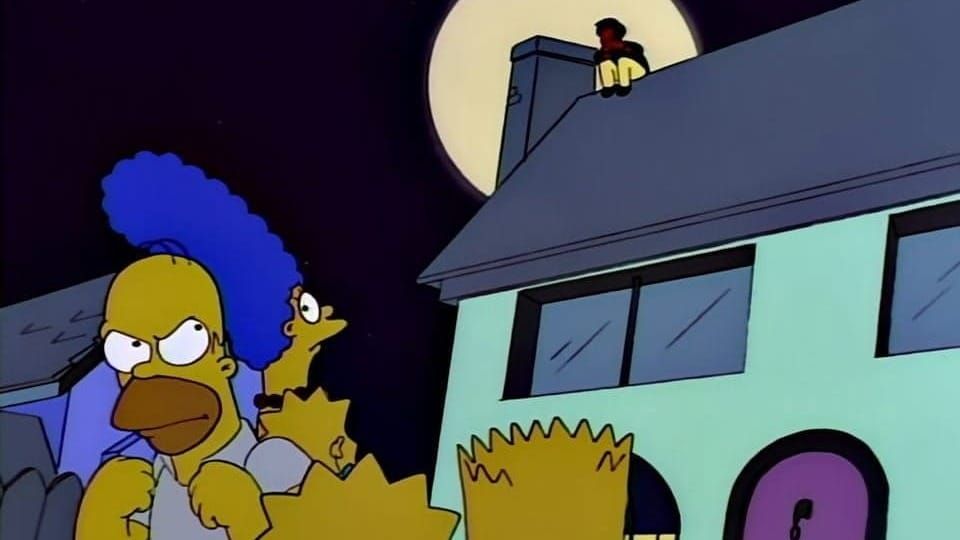
We turn now to Apu’s ‘Who Needs the Kwik-E-Mart?’ from Season 5 Episode 13 (‘Homer and Apu’). After giving Homer food poisoning from an expired hotdog, Apu is fired from his job managing the Kwik-E-Mart. He decides to come live with the Simpsons and perform chores for them to repay his karmic debt. Soon, they have embraced him as a member of the family; ‘I feel that way too’, he responds, before singing a song about how content he feels in his new life. The question ‘Who needs the Kwik-E-Mart?’ is posed several times, rhetorically, before being answered with a pithy ‘Not me’, coinciding with the song’s final cadence. However, the family later hear Apu weeping on the rooftop, eliciting Homer’s outraged accusation:
HOMER: Hey, he’s not happy at all! He lied to us through song! I hate when people do that!
The first thing to mention here is that, in contrast to Lurleen and Kirk, Apu is not a ‘musician’: he is not ‘singing a song he has written’ within the show’s fictional world. Instead, this is one of the rare cases in which The Simpsons permits ‘breaking out in song’, in the style of a Hollywood musical. Nevertheless, in this and all the examples subsequently discussed, The Simpsons writers make a variation on the same joke: they make it clear that, counter to the supposed conventions in which ‘singing’ in musicals is heard by the characters as some special kind of speech — rhetoric or confession or heightened expressivity — in the world of The Simpsons these moments are heard and discussed as ‘song’. In this case, ‘He lied to us through song!’. This functions as an absurdist joke, of course, suggesting the characters have a sort of meta-knowledge of the conventions that the show’s creators are playing with. But at the same time, it gives the characters access to a certain kind of analytical discourse. To talk of ‘song’ is to talk of the nature of discrete acts that are executed in and through singing — it is an Austinian register — and thus the question of ‘lying through song’ becomes an Austinian question.
So, why might lying through song be particularly aggravating to Homer, more so than lying through speech? And does Apu actually lie through song? How would such a thing function?
First, it’s worth thinking about the specific language Homer uses. It may be the case that what Homer is conveying by talking about lying through song is a kind of ontology of song whereby the words somehow precede the music. In this example, there first exists a lie (i.e., the false statement equivalent to ‘I do not need the Kwik-E-Mart’), and the song is a kind of medium through which this lie is conveyed.
However, this additive approach to song as ‘lyrics + melody’ or ‘words set to music’ is one that my whole project is attempting to challenge. How to Do Things with Words offers another perspective on, in this case, how to do things through song. When discussing a given speech act, Austin emphasises the difference between the locutionary act (the act of making a series of meaningful sounds/words); the illocutionary act (what is done in saying those sounds/words within a given situation); and a third type of act called the perlocutionary act, whereby an utterance produces ‘certain consequential effects upon the feelings, thoughts, or actions of the audience… and may be done with the design, intention, or purpose of producing them’ (Austin 1962: 101).
The successful performance of an illocutionary act does not necessarily lead to the successful production of its intended perlocutionary effects. I might perform the illocutionary act of requesting that you pass the salt (via the locutionary act of uttering the phrase ‘Please pass the salt’), with the intended effect of getting you to pass me the salt (or, ultimately, of obtaining the salt), but you might hear my request and choose to ignore it. I might perform the illocutionary act of propositioning you in my trailer one night, with the intended effect of having sex, but with the actual result of you fleeing the scene in a panic; in this case, the perlocutionary act fails only because the illocutionary act succeeds, securing recognition (or ‘uptake’) as a proposition for you then to reject.
APU: Who needs the Kwik-E-Mart? Not me!
‘To deceive’ is a perlocution, not an illocution. We might say that it is achieved not in but through this locution. The intended effect of ‘deceiving’ the Simpson family is produced here through an illocutionary act of ‘expressing’ or ‘affirming’ (via the locutionary act of ‘asking’ and then ‘answering’ a rhetorical question). Thus, there may be a distinction to be drawn here between Homer’s claim that ‘he lied to us through song’ (perlocution), and the hypothetical claim: ‘In singing, he lied to us’ (illocution).
To get a closer read on the situation, I think it’s worth considering another ‘out-of-the-blue’ musical-style number: in this case, an explicit Disney parody. ‘See My Vest’ (Season 6 Episode 20, ‘Two Dozen and One Greyhounds’) is performed by Mr Burns channelling Cruella de Vil, singing about his evil plan to make a fur tuxedo from the Simpsons’ greyhound puppies, while Bart and Lisa secretly spy through the window. We see here a song act functioning as it is generally supposed to function within the conventions of the Hollywood musical and beyond: as an act of disclosure. Singing is frequently understood as the faithful expression or revelation of some authentic inner state, and here Burns is revealing his secret plan. Unluckily for him, this revelation is overheard and the plan is thwarted.
We might assume that Homer has the same expectations of Apu’s song act: that, singing being singing, it ought to express one’s inner truth faithfully. One of Austin’s conditions for a felicitous performative is that ‘where…the procedure is designed for use by persons having certain thoughts, feelings, or intentions…then a person participating in and so invoking the procedure must in fact have those thoughts, feelings, or intentions’ (Austin 1962: 39). The violation of these conditions produces the type of infelicity that Austin labels an ‘abuse’.
Justin London, drawing on Simon Frith, has distinguished between ‘Two Kinds of “Bad” Musical Performance’: the first eliciting laughter (via incompetence), the second eliciting a kind of moral outrage. The examples that he gives for this second kind of ‘bad’ performance include offensive and self-indulgent music, alongside various forms of musical deception: lip-syncing, autotune, unacknowledged appropriations, and other types of ‘cheating’, which suggest the existence of a set of unspoken criteria (depending on the musical genre and context) that are thus being violated (London 2021). When Homer ‘hates when people do that’, he is clearly expressing this second kind of reaction, in relation to a set of expectations concerning the relationship between sincerity and song specifically.
But there are two things to add here: first of all, it should be pointed out that Apu’s 'inner truth' — the fact that he does indeed need the Kwik-E-Mart — is ultimately disclosed through song, when the Simpsons overhear him singing to himself on the roof, eliciting Homer’s outburst. Indeed, the 'true' answer to the song's titular question — 'I do!' — is more fully sung (in a mournful falsetto) than the half-spoken 'Not me!': the specific moment of untruth, which concludes the song the first time around.
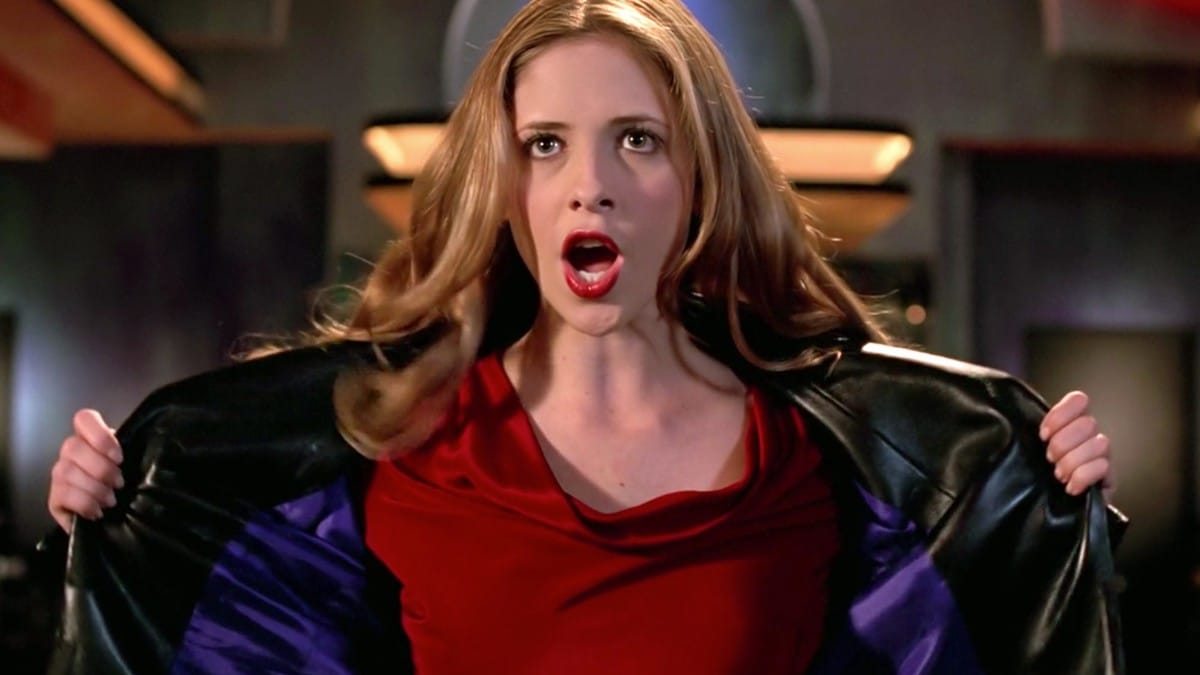
Secondly, it’s worth emphasising that such musical revelations, as conceived in musicals, are active rather than passive. They are not generally represented as an unpleasant, uncontrollable bursting out — as parodied in the famous Buffy episode ‘Once More, With Feeling’, when characters are forced by an evil demon to disclose their secret thoughts and feelings through song — but rather as an intentional act within a given situation. In Burns’s case, he is bragging, boasting, making a spectacle of his deviousness, commanding all within earshot to ‘see’ his vest. ‘See My Vest’ is a satisfying turning point in the episode’s plot because it is his act of boastful hubris that leads to his downfall.
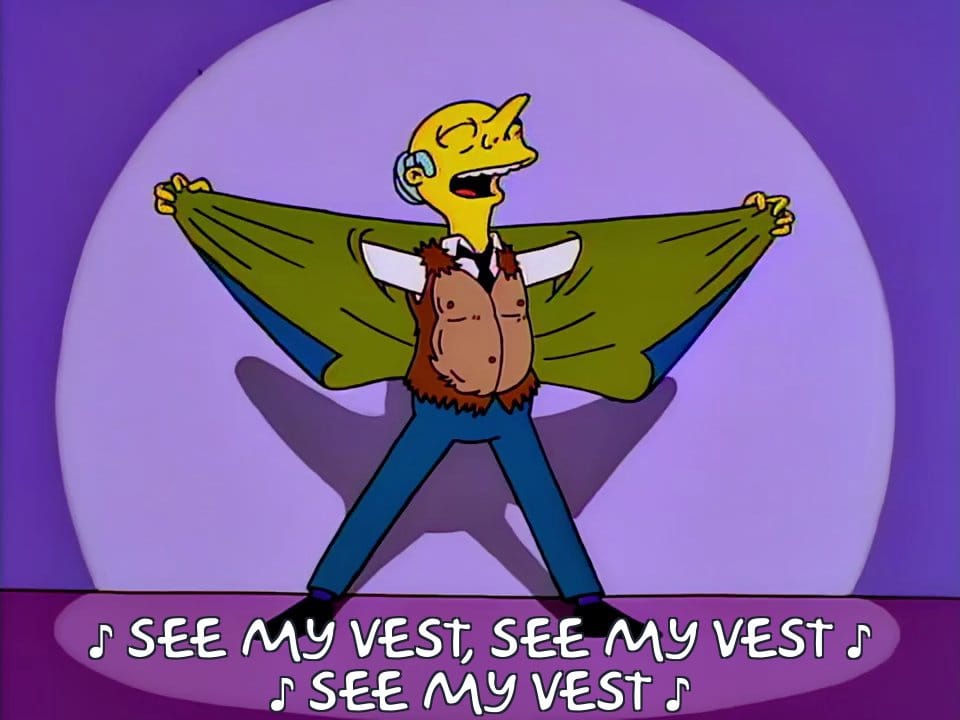
Indeed, for Burns, the song act is too successful. The song is, of course, a play on ‘Be My Guest’ from Beauty and the Beast, and we might see its excessive efficacy as a kind of by-product of this act of parody, necessitating a strange shift from the illocutionary to the perlocutionary. The punning refrain ‘See my vest’ is not a phrase that anyone would ordinarily say; ‘Look at my vest’ would be more common, constituting an illocutionary request, drawing attention to something. Taken at face value, the injunction ‘See my vest’ would appear to skip over this request, going directly to the perlocutionary effect of the request: that my vest be seen rather than just looked at. Thus, as is so often the case with perlocutionary speech acts, it appears to slip into the realm of the magical, suggesting a kind of ‘clairvoyance-on-command’ (imagine a wizard pointing a wand and commanding: ‘Sleep!’, ‘Fly!’, or ‘See my vest!’). The overall situation is one of ‘be careful what you wish for’: in commanding that his vest be ‘seen’, Burns allows Lisa to see his true intentions. (Although, in another iteration of the ‘meta’ joke mentioned above, Bart only hears a catchy tune.)
But what actually is a boast? Perhaps nothing more than an ostentatious truth: an indecorous excess of truthfulness, a fact that draws too much attention to itself, that is too ‘showy’. One common conception of song might be as a way of ‘showing feeling’; Apu’s strategic use of song would thus be a way to demonstrate feeling, for the (perlocutionary) purposes of convincing or reassuring. His ability to ‘pull off’ a ‘happy song’ — to ‘perform happiness’ in this case — is built into the affective experience of the music: hearing it as ‘happy’ is a form of ‘proof’, determining our response to a sung utterance over and above the kind of objective adjudication that we might apply to a comparable spoken claim (e.g., ‘I am content with this situation’).
Following Austin’s work on ‘Pretending’, we might consider Apu’s song as an act of pretence: the performance of a particular type of behaviour (‘being happy’, or ‘not needing the Kwik-E-Mart’) to mask the ‘real’ state of affairs (‘being sad’, or ‘needing the Kwik-E-Mart’) (Austin 1979). Austin suggests a distinction between, for instance, a) ‘Apu is pretending to be happy’ and b) ‘Apu is pretending that he is happy’. The difference is subtle but, I think, intuitive. ‘Apu is pretending that he is happy’ points to a deeper, more internal act of pretence than ‘Apu is pretending to be happy’; it raises the possibility of ‘self-deception’, of ‘pretending to oneself’. It is quite conventional in musicals, for instance, that characters can cheer themselves up by singing and dancing as if they were happy. A performance of the ‘behaviour’ of happiness can, such numbers suggest, conjure that emotional state into being. So, perhaps, if Apu is lying, it is to himself first and foremost.
'Put On a Happy Face' from Bye Bye Birdie: a classic 'act happy to become happy' number
I’ve tried to think of other fictional situations in which we might make the same charge of ‘lying through song’. Musical numbers are frequently used in acts of deception, often to create a distraction: see, for example, Nancy’s ‘Oom-Pah-Pah’ from Oliver! or ‘Sisters’ from White Christmas. In other cases, a character may use a song as part of a disguise, performing their feigned identity in an audibly convincing way (I’m thinking of ‘Doll on a Music Box’ from Chitty Chitty Bang Bang, ‘Prince Ali’ from Aladdin, Baloo joining in with The Jungle Book’s ‘I Wanna Be Like You’, countless opera buffa arias). We might proffer Chicago’s ‘We Both Reached for the Gun’ as a particularly perfect instance of a musical lie, to which I will return in the next post.
But there are plenty more ambiguous examples. At the end of The Sound of Music, the Von Trapps use ‘So Long, Farewell’ to mask their real exit from the music festival, under the guise of a simulated (performed) exit, thus deceiving the Nazis by being unexpectedly sincere in their act of leave-taking. ‘Stay Awake’ from Mary Poppins is an example of a song act whose intended perlocutionary effect (to lull the children to sleep) is totally at odds with its purported illocutionary force (instructing them to stay awake). ‘Sit Down You’re Rocking the Boat’, from Guys and Dolls, is an act of faux repentance on the part of the sinning crapshooters that appears morally justified, saving the Salvation Army Mission even as it undermines its stated purpose. And while Judy Garland has delivered a plethora of perlocutionary injunctions, promising that real happiness might be performed into existence — ‘Get Happy’ (Summer Stock), ‘Have Yourself a Merry Little Christmas’ (Meet Me in St Louis), ‘Be a Clown’ (The Pirate) — the equivalent in 1954’s A Star is Born, ‘Lose That Long Face’, is shown, as with Apu, to be a mere act.
What is it about a song that allows it to function in these various ways? We might say that it is a mode of utterance whose commitment to fulfilling its own aesthetic criteria — conventional schemes of rhyming, repetition, metre, the creative use of poetic devices — can legitimately override the demands put on other modes of utterance: i.e., sincerity, truthfulness, responsibility, consistency, cogency, relevance, etc. ‘Doing things through song’ imbricates the speech act in a variety of other ‘musical’ goals and priorities, which can then function as alibis or excuses: the need to provide a rhyme, to get to the chorus, to repeat the refrain, to hold a long note, or in Apu’s case, to come to a final cadence. His actual verbal ‘lie’ — the final ‘Not me!’ — could thus be explained away as a structural demand of the song itself, required for the singing of the song into existence, and thus for the successful execution of the ‘Who Needs the Kwik-E-Mart?’ song act as such.
In another article, London uses the perfect cadence (the chord progression from V to I that produces a sense of finality and closure) to propose a music-specific equivalent to Austin’s taxonomy, which he terms ‘tonary’, ‘intonary’ and ‘pertonary’ (London 1996). While I do not share London’s approach, in that I do not tend to hear instrumental music as the ‘utterance’ of a composer in the way that he suggests for Haydn’s "Joke" Quartet, I do think it worth considering the tensions between the ‘speech’ acts performed in/through sung language as it is uttered, and the musical acts (ascending, resolving, cadencing, ornamenting) that are performed in/as this utterance.
Andrew Chung, in what seems to be the most thorough application of speech act theory to musicology so far, extends London’s approach by proposing musical equivalents to Austin’s various categories of illocutionary acts. In discussing the category of ‘commissives’, which ‘commit [the utterer] to certain courses of action’ (e.g., promising, betting, threatening, etc.), he suggests that ‘a simple dominant pedal in Western tonal syntax’ might be heard as ‘[giving] something like a promise to resolve in a certain way at a certain time — a promise which may be kept, deferred, or broken’ (although he adds that ‘a lack of expected resolution is hardly the moral equivalent of a broken promise’) (Chung 2019: 2.2.5). Such tonal acts, Chung goes on to imply, might then ‘collectively perform a higher-order act of committing to [a tonal] idiom’.
So perhaps, in uttering his cadential lie, Apu is also keeping a promise. To break into song is, first and foremost, to commit to keep singing the song until the end, to go through all the little musical actions needed to make this song ‘become itself’ (a good song, a happy song, a tonal song, this song). In this way, we might see the initiation of sung action as a way to ‘get out of’ other obligations concerning social action (including spoken utterance): ‘breaking into song’ as a way of ‘breaking out’ of a sticky situation.
References:
- J. L. Austin (1962), How to Do Things With Words, Harvard University Press.
- J. L. Austin (1979), ‘Pretending’, in Philosophical Papers, Oxford University Press: 253–271.
- Andrew J. Chung (2019), ‘What is Musical Meaning? Theorizing Music as Performative Utterance’, Music Theory Online 25(1).
- Simon Frith (2004), ‘What is Bad Music?’, in Christopher J. Washburne & Maiken Derno (eds.), Bad Music, The Music We Love to Hate, Routledge: 15–36.
- Justin London (1996), ‘Musical and Linguistic Speech Acts’, The Journal of Aesthetics and Art Criticism 54(1): 49–64.
- Justin London (2021), ‘Two Kinds of “Bad” Musical Performance: Musical and Moral Mistakes’, The Journal of Aesthetics and Art Criticism 79: 328–340.