J. L. Austin in Springfield (1)
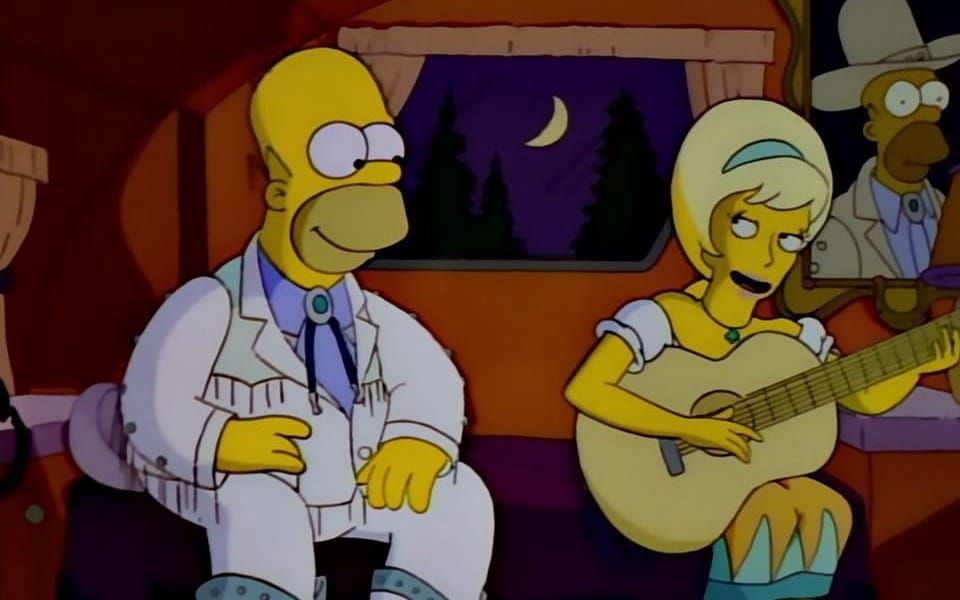
I was rewatching old Simpsons videos, early on in my PhD process, when I came across this musical moment from Season 3 Episode 20 (‘Colonel Homer’). Homer is managing the career of waitress-turned-country music singer Lurleen Lumpkin, who has secretly fallen for him. We see the two of them here, alone in Lurleen’s trailer, sat on her bed: she is singing a newly written song for Homer, called ‘Bunk With Me Tonight’.
It struck me that this scene provides a rather beautiful illustration of one of the central ‘problems’ of my thesis, relating to the differences between singing and speaking, and the potential applicability of J. L. Austin’s philosophy of language to sung utterances. On this basis, I began to think through various other musical moments from the show’s so-called ‘golden age’ of Seasons 3–8, as they might help introduce some of the ideas at work in my project.
As seems to be peculiarly the case for cartoons (or American cartoons, at least), The Simpsons represents a fictional world in which musical actions are not mandatory (like in a musical or opera), but they are possible. Nevertheless, in this case, such musical acts are also relatively rare. I found myself asking what kind of situation ‘calls for song’ in the world of The Simpsons? Such situations aren’t generally engineered to derive comedy from satirising musical styles or genres per se, or even to send up the absurdist conventions behind Hollywood/Disney musicals (in the manner of comedies like Flight of the Conchords, Schmigadoon! or Crazy Ex-Girlfriend). Instead, with typical sophistication, the Simpsons writers use the representation of song acts to indulge in a form of Austinian philosophizing: revealing the contradictions underpinning certain modes of action and their tendency towards failure. The Simpsons is a situation comedy in which song is used to stage the comedic failure of the speech act situation.
What does all this mean? Let us return to Lurleen Lumpkin, who will explain…
In this scene, Lurleen is singing a new song for her manager Homer, but she is also — or perhaps we could say, she is ‘really’ — doing something else. We might say she is ‘propositioning’ him: the act of singing this song in this situation constitutes, for Lurleen at least, an act of propositioning.
For Homer, though, it is just a song. He does not understand her intention. Lurleen is forced to repeat herself, stripping away the musical arrangement and ultimately shifting from song to speech, in order to make herself understood. Yet the moment the ‘true meaning’ of her song is successfully conveyed, it promptly fails in its intended effect: Homer reacts with shock and rejects her proposition, fleeing the scene.
So, what’s the joke here? Unlike the show’s audience, Homer fails to interpret the social conventions by which a private performance of an intimate song for a friendly acquaintance on a bed might function as an invitation to physical intimacy. This in spite of the fact that Lurleen’s song spells out the precise nature of the act that it conceals: not just by explicitly asking the question ‘Will you bunk with me tonight?’, but by stating the fact that she is asking this question: ‘I’m asking “Will you bunk with me tonight?”’.
But how stupid is Homer actually being? The humour comes from the fact that we understand his confusion. We recognise the ambiguity of the situation. The question remains open: does singing the statement ‘I’m asking “Will you bunk with me tonight?”’ actually constitute the act of asking “Will you bunk with me tonight?”? And if not, why not? Is it in fact possible to ‘ask’ anything in song? Is it possible to state anything?
When I try to describe my PhD topic to people, I’ve found that one of the most successful routes is to suggest a definition of ‘musical performance’ in terms of a distinction between musical and non-musical action: a threshold that is crossed, for example, when we ‘burst’ or ‘break into song’. What changes when our actions become musical, when music ‘breaks out’, whether onstage, in ritual, or in everyday life? What is the nature of this ‘break’? What is ‘broken’?
The legacy of British philosopher J. L. Austin (1911–1960) provides an obvious approach to answering these questions, via the theory of the ‘speech act’: speaking as a mode of action. As a progenitor (along with Wittgenstein) of what has come to be called ‘ordinary language philosophy’, Austin was concerned with the ways in which our everyday use of words might reveal something about the nature of action (one famous example being the difference between doing something ‘accidentally’ and doing it ‘by mistake’: see Austin 1979a). But his most influential contribution was the idea of the ‘performative utterance’, popularized through the publication of How To Do Things With Words (an influential series of lectures from 1955, published posthumously).
To summarize this well-known concept very briefly: ‘performatives’ are a type of utterance that, in contrast to so-called ‘constatives’, do not describe or report anything and thus cannot be ‘true or false’. Instead, to utter the sentence is to perform an action. Saying makes it so. Austin gives the examples of saying ‘I do’ during a marriage ceremony, as well as promising, betting, apologising, declaring war, etc.
Later in the book, Austin extends this framework of ‘speech as action’ to all utterances, including ‘constatives’ (which might be said to perform the act of ‘describing’, ‘reporting’, ‘informing’, etc). At this point, he introduces the term ‘illocutionary force’ to name the action that a particular speech act performs in its utterance. For example, uttering the phrase ‘Will you bunk with me tonight?’ — within the specific context (or situation) of an intimate moment shared on a bed — might have the illocutionary force of ‘asking’ (demanding a response), as well as ‘propositioning’ (laying forth a plan of action and inviting participation, specifically regarding sexual intercourse).
Austin pays extensive attention to the conditions that need to be in place for such speech acts to be performed successfully, or ‘felicitously’ in his jargon. He discusses several ways in which a speech act can fail. This is part of what he calls his ‘long-term project of classifying and clarifying all possible ways and varieties of not exactly doing things, which has to be carried through if we are ever to understand properly what doing things is’ (1979b: 271).
So, following the principles of speech act theory, we can reframe the question of the differences between musical and non-musical action in terms of the threshold between speech and song. Austin never discusses singing, but it seems to me that one of the things that is broken when we break into song is precisely the ‘performativity’ of a speech act. To sing an apology or a promise, or even a coffee order, would — I’d suggest — at the very least raise the question: ‘Are you serious?’ The question of seriousness here recalls one of Austin’s most controversial paragraphs, in which he suggests that ‘a performative utterance will…be in a peculiar way hollow or void if said [for example] by an actor on the stage, or if introduced in a poem’. For him, this is a case of language used ‘not seriously, but in ways parasitic upon its normal use’ (1962: 22).
So let us return once again to Lurleen and Homer sitting on the bed. Her song act of proposition fails to function as a proposition, because Homer does not take it as such. It is what Austin might call a ‘misfire’. So why (like so many other bedroom serenaders) does she sing here, instead of just coming out with it in plain speech? Clearly, the non-seriousness of the sung utterance affords something specific to the act of propositioning, which is plausible deniability. Again, the writers satirically thematize this by enclosing the song’s titular request in quote marks within quote marks within quote marks. The lyrics go ‘In this trailer I get so cold and lonely / Lying here awake at night / Muttering: ‘If only you weren’t married / So I might ask you to / “Bunk with me tonight” etc.
Thus, one of the affordances singing has is as ‘non-speech’; when singing, we can ‘say something’ without having to say it. To put this another way, we can give a 'performance' of speaking without actually performing the speech act. The classical Austinian meaning of the word 'performative' (doing a thing) here gives way to its contemporary antonymous sense ('merely performative', i.e., not really or sincerely doing the thing (another Austinian question: how does 'really' relate to 'sincerely'?)). Such euphemistic song utterances require a certain failure of ‘seriousness’ to function; but here, this failure fails: Homer is too literal-minded, or in this case, perhaps not literal-minded enough. A more tactful Homer might have subtly signalled his comprehension and declined her offer while keeping everything unspoken. Instead, Lurleen is forced to articulate her desire in plain speech, leading to a crisis that damages their relationship irrevocably.
Let’s turn here to a second example: a similar scenario, and another song act that ‘fails to fail’ felicitously, for different reasons.
‘Can I borrow a feeling?’ is, incidentally, a much-debated question in the philosophy of music
So here is Kirk van Houten’s last-ditch attempt to win back his wife Luann following their separation (Season 8 Episode 6: ‘A Milhouse Divided’). Once again, it fails spectacularly, not just in its intended effect, but in functioning felicitously as a song act. For one thing, Kirk prefaces his performance by announcing ‘I’ve got something I’d like to say!’… and then starts singing. Luann is initially nonplussed; he is forced to clarify the ‘thing’ he’d ‘like to say’ by saying it — ‘Will you marry me... again?’ — and only then, when the illocutionary force becomes clear (when its ‘uptake is secured’, in Austin’s terms), can Luann clearly reject him: ‘Ew no!’.
Is it possible, then, to ‘felicitously’ propose marriage to someone in song? There are various examples, in movies and on Youtube, of proposals intimately sung or else lip-synced with elaborately staged with flashmob-style dances… but even if you sang the literal words ‘Will you marry me?’, could that ever unambiguously count as a marriage proposal? And what if the addressee sang their response in turn: ‘Yes, of course’? Would that count as getting engaged? Maybe? (We might ask the same of the declaration of love: another speech act that attracts musical stagings while demanding sincerity.) Somehow, singing instead of speaking produces an ambiguity that cannot easily be resolved. In almost every case I’ve seen, a big song-and-dance marriage proposal is followed up by a spoken proposal: ‘So, how about it?’ Unlike a sexual proposition, a marriage proposal has no use for plausible deniability.
It is worth noting that both Lurleen Lumpkin and Kirk van Houten are ‘musicians’: in these examples, they are both ‘singing songs they have written’ within the fictional world of the show. The key difference is that Lurleen is a good musician, and Kirk is a bad musician. Her song is artful and his is artless. And as Claudia Gorbman (2011) has argued, ‘artless singing’ has its affordances. It is without art, and therefore without artifice, leaving nothing but raw and vulnerable sincerity, exposed in public. The authenticity of Kirk’s feelings is beyond doubt. The joke, of course, is that he fails anyway, and is doubly humiliated. His song act fails to do the thing that bad song is supposed to do in the romantic comedies whose conventions he is invoking, of which his estranged wife Luann appears to be oblivious.
A felicitous example of artless singing, from the movie Parenthood (1989)
And what of Lurleen? Could it be the case that her status as musician somehow also militates against her capacity to act through music? We might posit a tension between ‘singing’ and ‘song’. Singing instead of speaking is a surefire way to make an utterance sound insincere, as if it is meant unseriously. Song, however, is supposed to be a medium of extra-ordinary sincerity: a device for the expressing or communicating of hidden, inner truth. Song makes singing sincere, but this form of sincerity is somehow ‘trapped’ in the ‘bracketed off’ space-time of the song and its performance, along with the (fictional) ‘speech situation’ conjured by the lyrics, in which (for instance) the fictional Lurleen is asking her question to the hypothetical unmarried Homer of her dreams. As a result, her utterance lacks the kind of ‘purchase’ that would allow it to act in the everyday world. (Hence, her need to convert the (formal, orchestrated) song back into (unaccompanied) singing, and finally to the implied speech act at its core — ‘That’s right, Homer J!’).
What is the relation of this form of sincerity to truth? Austin introduces the performative utterance as one in which, unlike the ‘constative’, cannot be conceived in terms of true or false. To say ‘I apologise’ is not to describe or report on the truth status of a separate 'inward or spiritual act' — the act of apologising — that takes place independently of the utterance (1962: 9). To say ‘I apologise’ is to apologise; rather than true or false, it is either 'happy' [successful/efficacious] or 'unhappy' [fails as an apology]. And yet Austin goes on to complicate this initial distinction, pointing out that ‘if the performative utterance “I apologize” is happy, then the statement that I am apologizing is true’ (1962: 53). So, is Lurleen’s (sung) statement ‘I’m asking “Will you bunk with me tonight?”’ here equally true? Is it actually possible to state anything truthfully in song?
I’ll return to this issue in the next post, when I investigate Homer’s provocative philosophical proposition: ‘He lied to us through song’.
References:
- J. L. Austin (1962), How to Do Things With Words, Harvard University Press.
- J. L. Austin (1979a), ‘A Plea for Excuses’, in Philosophical Papers, Oxford University Press: 175–204.
- J. L. Austin (1979b), ‘Pretending’, in Philosophical Papers, Oxford University Press: 253–271.
- Claudia Gorbman (2011), ‘Artless Singing’, Music, Sound, and the Moving Image 5(2): 157–171.